

Representative picture.
| Photo Credit: Creative commons
You must have heard about the Y2K aesthetic and Y2K fashion, but have you heard of the Y2K problem? Also known as the Millennium Bug, the Y2K problem was one of the most anticipated technological crises at the beginning of the 20th Century. Started as a simple programming flaw which people did not think through futuristically, the Y2K problem ended up disrupting the entire world.
What was the problem?
The origin of the Y2K problem goes back as far as the 1960s and 1970s, when computing resources were limited, and computers had minimal memory. Programmers saved space by abbreviating years to two digits — using “99” for 1999 rather than “1999.” This “YY/MM/DD” format became standard in languages like COBOL, which dominated business and government systems back then.
As the year 2000 approached, computers risked misinterpreting “00” as 1900, not 2000. This simple error could affect date-dependent operations, from financial calculations to equipment maintenance logs. The potential fallout of this was dire.
Banking software might recalculate interest by a century, invalidating loans or pensions. Power grids could misread sensor timestamps, causing blackouts. Airlines faced flight scheduling chaos, while hospitals’ patient records or medical devices glitched. The possibilities were endless. By 1995, experts like Peter de Jager (a South African-born Canadian computer engineer known for one of the earliest Y2K threat outcry) publicised the “date rollover” threat, coining “Y2K” for Year 2000.
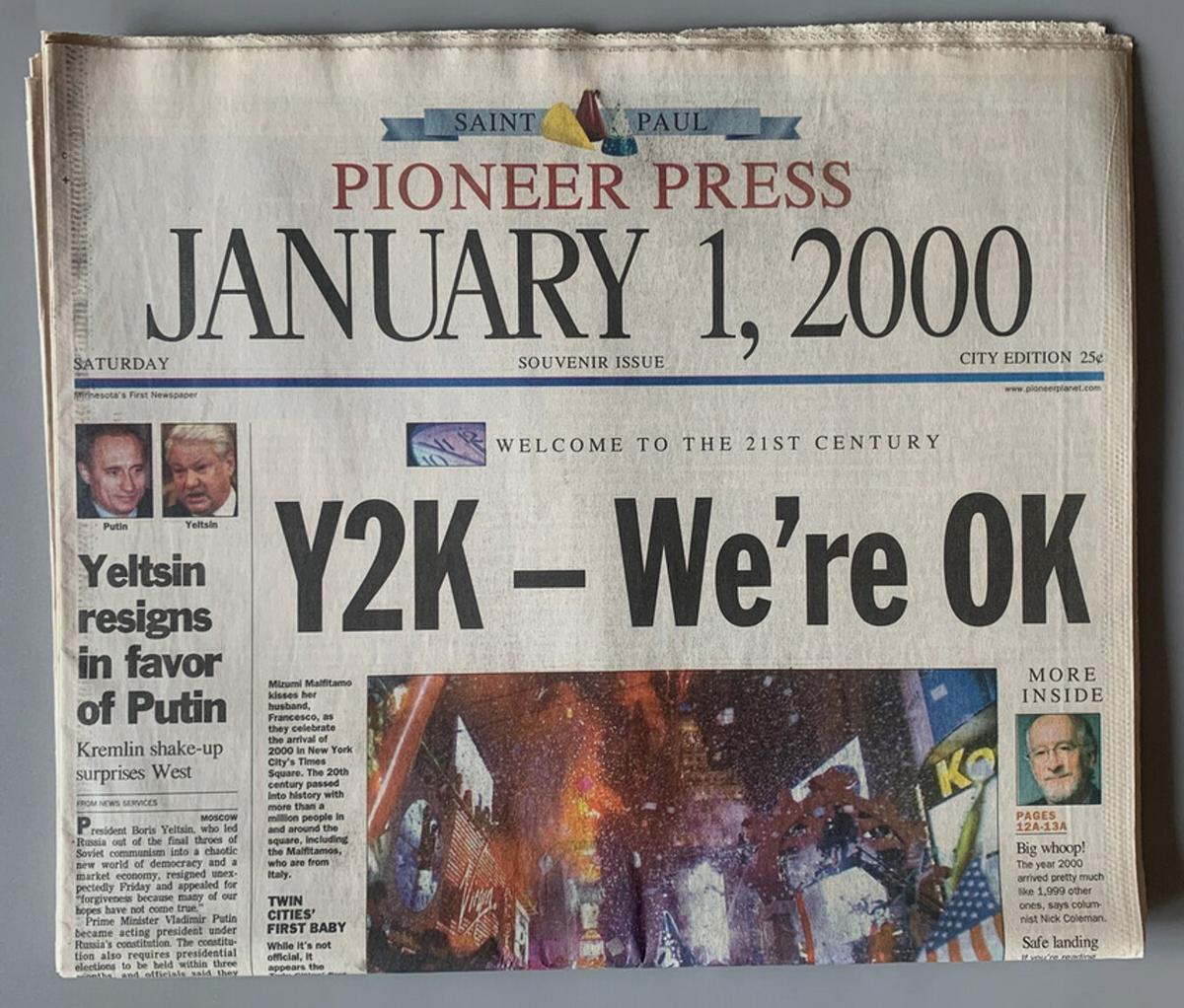
A newspaper from the year 2000.
| Photo Credit:
Creative Commons
Chaotic wait
Countries worldwide were being affected in multiple ways due to the Y2K problem, especially the ones pioneering technological developments. Developing countries, with fewer computers, faced ironic advantages but still risked imported failures.
Y2K’s scope was unprecedented as well, affecting 5,00,000 organisations worldwide. Thousands of programmers tackled “legacy code,” rewriting billions of lines. The UK formed a Y2K task force; Japan audited 1.5 million systems. International bodies like the UN and World Bank shared best practices. Public campaigns urged cash hoarding and supply stockpiling, sparking “Y2K kits” sales and the media frenzy peaked with predictions of societal collapse. Through the Y2K porblem India emerged as a remediation powerhouse, its nascent IT sector fixing Western systems and gaining global trust.
Aftermath
As New Year’s Eve 1999 arrived, the world held its breath as celebrations welcomed a new era. From Sydney’s fireworks to New York’s Times Square ball drop, billions watched. At 00:00:00 UTC, systems worldwide ticked over and relief flooded. There weren’t major glitches — a South Korean tower clock reset, U.S. slot machines paid out erroneously, and a Japanese reactor halted safely. No planes fell, grids collapsed, or economies imploded.
Philosophically, the Y2K problem raised questions about technological dominance, evoking dystopian fears while affirming human control. Today, amid uncertainties surrounding AI and quantum threats, the millennium bug serves as a reminder that the promise of technology depends on our vigilance.
A few glitches which happened due to the Y2K problem were:
1. In South Korea, a university sent graduation certificates dated 13 January 1900 to it;s students.
2. In Denmark, a baby born on January 1, 2000, was recorded as being 100 years old.
3. In Norway, a day care centre for kindergarteners in Oslo offered a spot to a woman over 100 years old because the citizens’ registry only showed the last two digits of citizens’ years of birth.
Published – March 28, 2026 09:00 am IST

